Why He Points And Grunts Instead Of Asking
The short version
A first-words book is usually a crowded page, and a crowded page gives a one-year-old nothing to land on. These are the opposite: one word, one picture, and a part he can work with his hands so he asks for the same page again. Ten books, one word a page, $44.99 for the set.1 The whole routine is five to ten minutes on a lap.
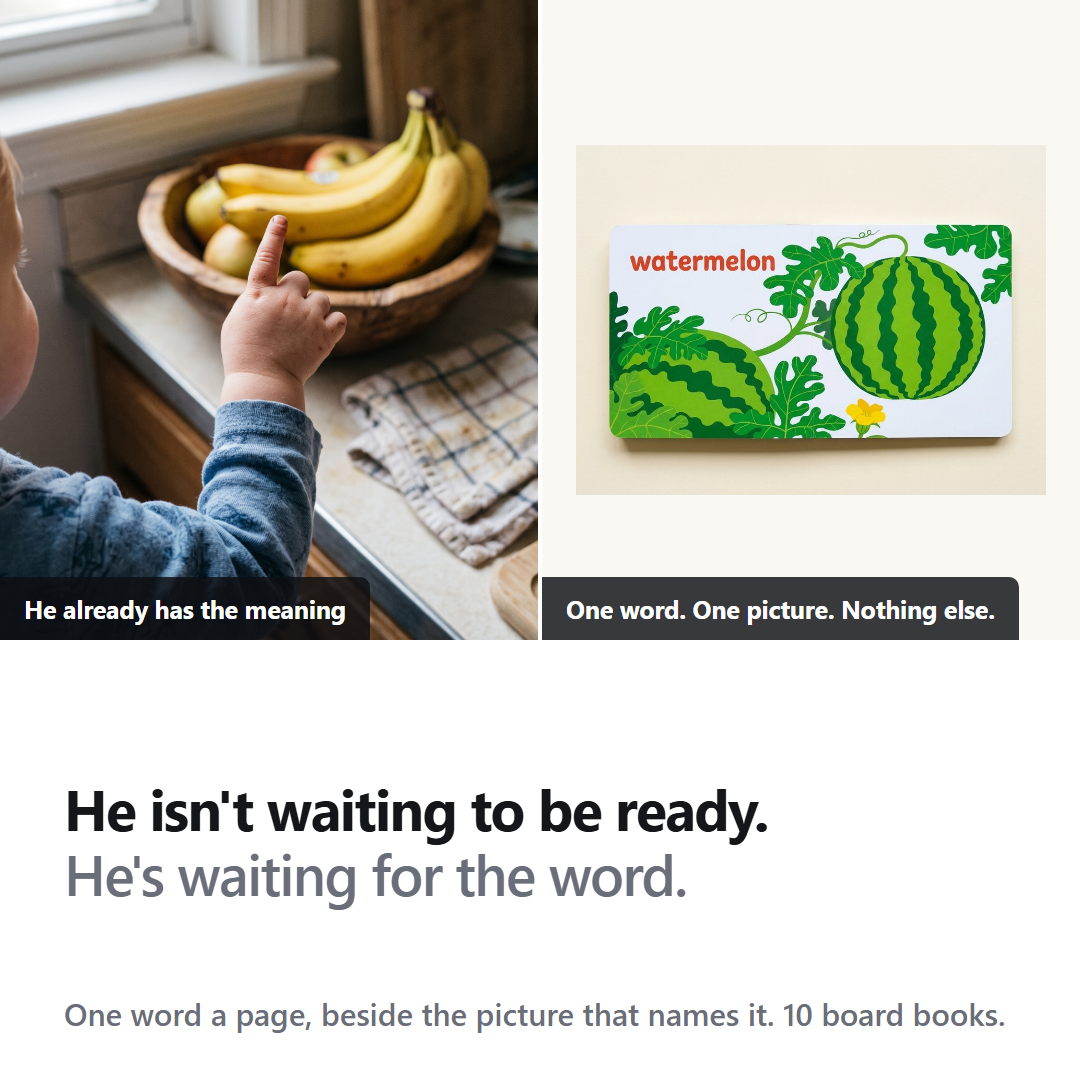
He stood at the counter, reached up toward the fruit bowl, and made a sound.
Not a word. A sound, and a finger, and a look at me to check I had understood.
And I had. I knew precisely what he wanted. I have known every single time, for months, which is the detail that kept catching on something in my head at about two in the morning.
He is not confused. He is not uninterested. He knows exactly what he means. He simply does not have the word for it, so he hands me a gesture and I hand him back a banana and we both get on with the morning.
I had been counting his words for about six weeks by then, in the way you count without ever deciding to. And every time I counted I was measuring the wrong thing, because the gap was never in what he understood. He follows instructions. He finds his shoes. He knows the difference between the red cup and the blue one and he will tell you about it at volume.
The gap is only in what comes back out.
Then somebody told me the bit nobody had told me
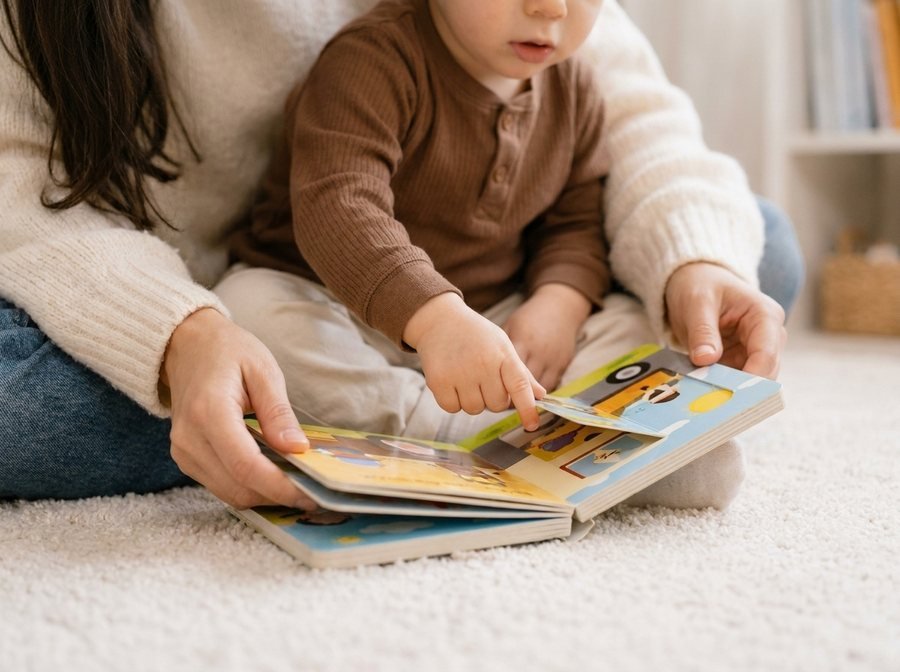
A child does not collect a word the first time he hears it. He collects it somewhere around the twentieth, attached to the same object, in a voice he already knows.
Twenty. Not twice.That is the number nobody mentions.
So when you say "banana" once while handing it over, that is not a lesson. That is one twentieth of a lesson, delivered while his hands are full and his attention is on the fruit.
Which sounds like an argument for simply saying it more. It is not, quite, and this is where I got stuck for a long time. You cannot say a word twenty times to a one-year-old by deciding to. By the fifth you feel like a broken machine. By the eighth he has gone to find something better.
He has to want to hear it twenty times. That was the part I could not solve by trying harder.
It was never you. It was the page.
Here is what I had not thought about once: every book I owned was working against me.
Go and get one off your shelf. Open it in the middle. Actually do it, because this is much easier to see than to be told.
Count what is on that spread. There is a sentence, often three. Two illustrations, sometimes four. A story that only pays off if he is still there at the end. And somewhere in all of that, in the same size and the same color as everything else, is the one word you actually wanted him to hear.
Now be eighteen months old with forty words. You are not reading that page. You are being shown a room where a dozen people are talking at once and asked to pick out one voice.
He points at the fruit bowl because the fruit bowl has one thing on it. The page has thirty.
Another parent put it better than I ever have: "Too many words to too many pictures."
But here is what got me the most
Every piece of advice I had been given was about me. Read to him more. Talk constantly. Narrate what you are doing. Be consistent. Be patient.
Not one of them was about the page.
Every one quietly assumed the book was a neutral object, and that the only variable was how much effort I was prepared to put in. So when it did not work there was precisely one thing left to blame, and I had been blaming it for the better part of a year.
And the bookstore does not help. The lovely recommended hardback, the one three people told you about, is built for a child who can follow a story. It is a genuinely beautiful book and it is one stage ahead of him. You are not buying badly. You are buying one stage early.
The Almost-Empty Page: the two things that make it work
There are only two ideas in these books, and neither is clever.
One: nothing competes with the word. A page has one word on it, printed large, next to the one picture that names it. That is the whole page. No sentence to follow. No second illustration pulling his eye off it. Nothing else to look at.
He finds the word because there is nothing else to find.
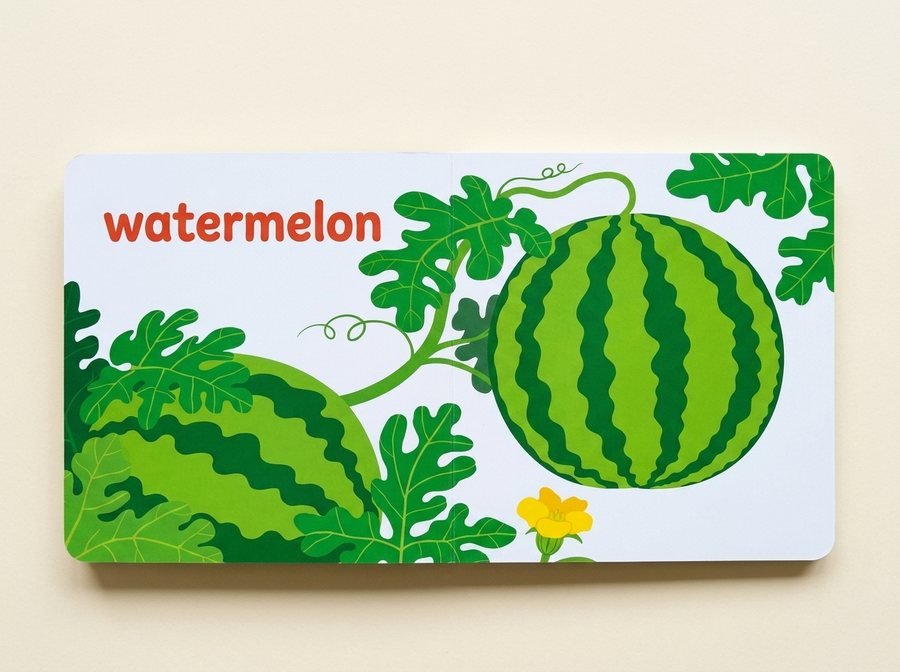
There is one short line underneath in small type, for you. The watermelon is round like a ball. Read it or do not. It is not the part that is for him. The word is the part that is for him. It sits on its own, with a lot of white space around it.
That space is the entire design. It is also why the page looks almost unfinished the first time you open it.
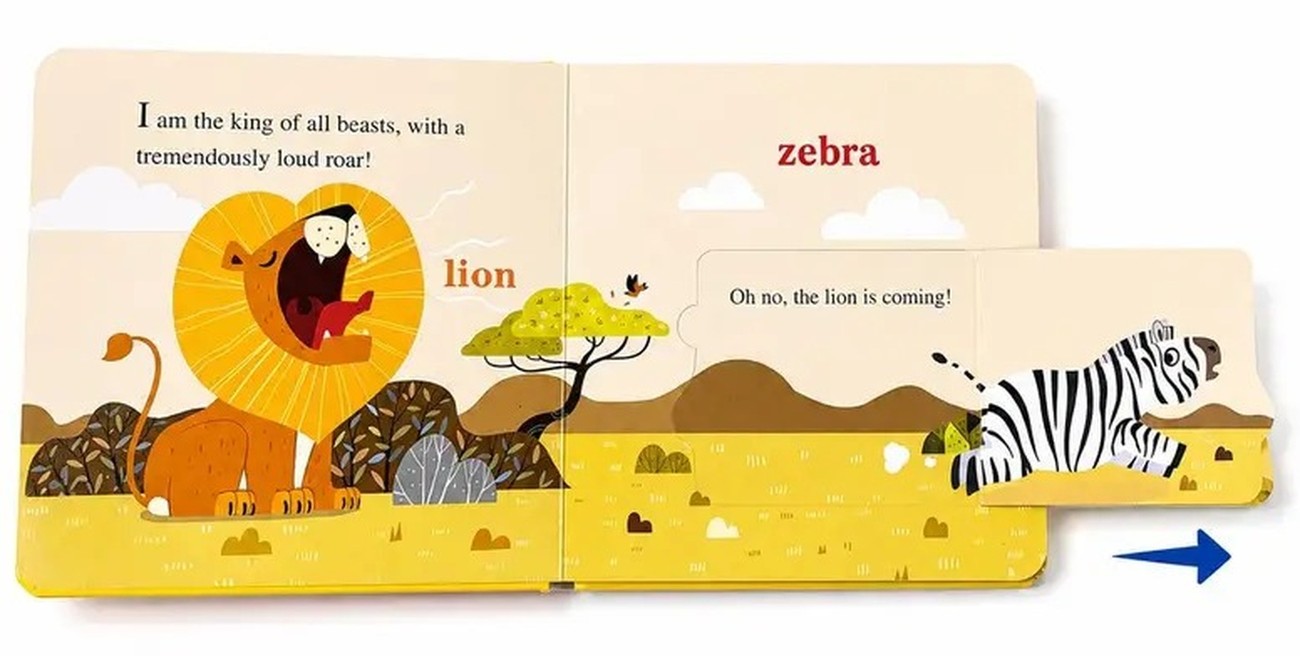
Two: he asks for it again. Every page has something to work with his hands.
A flap that lifts to show what is underneath. A slider that runs in a track cut into the board, so the elephant moves when he pushes it. A tab that pulls the zebra sideways out of the page and past the edge of the book, which is the one he will do forty times.
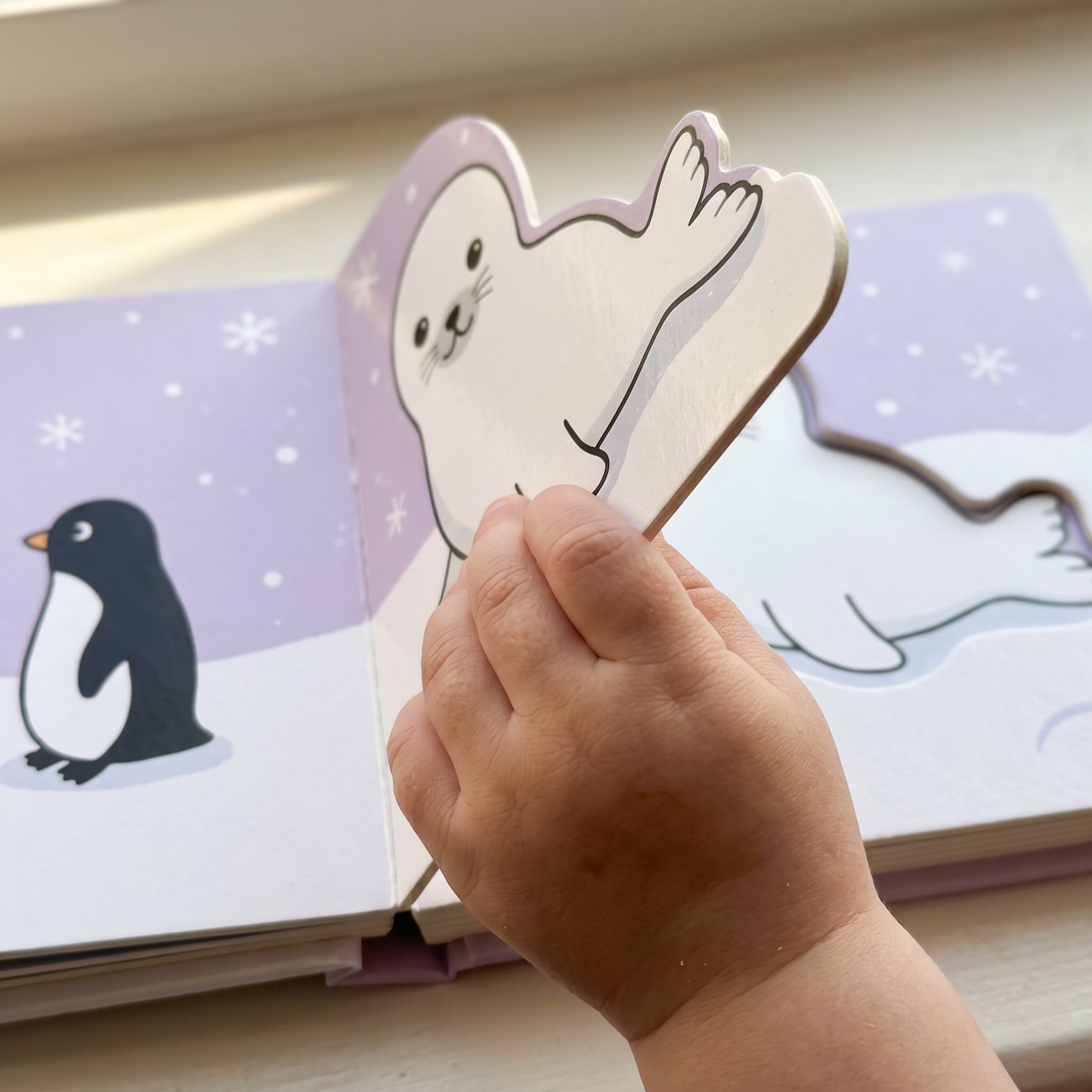
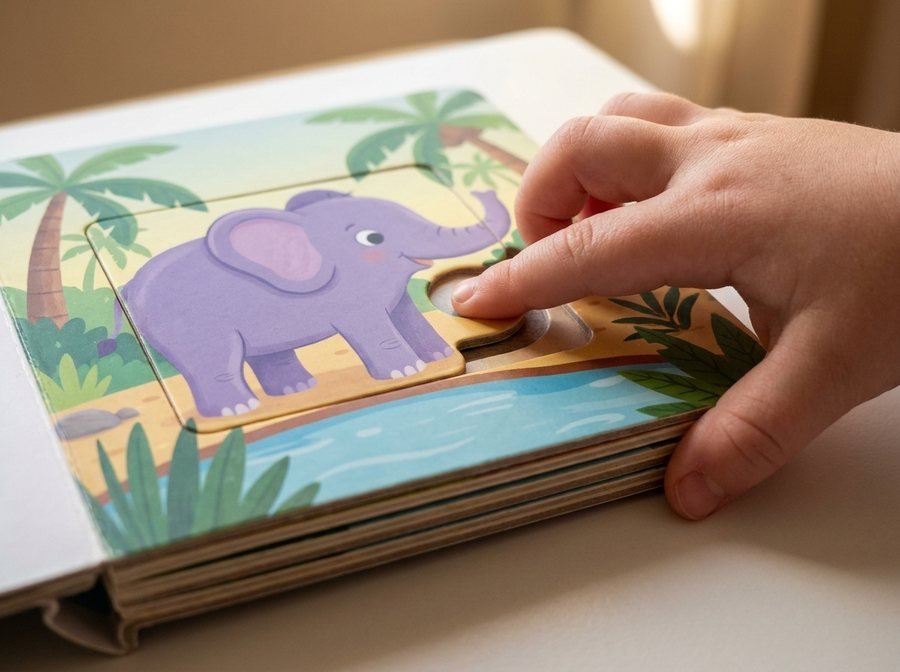
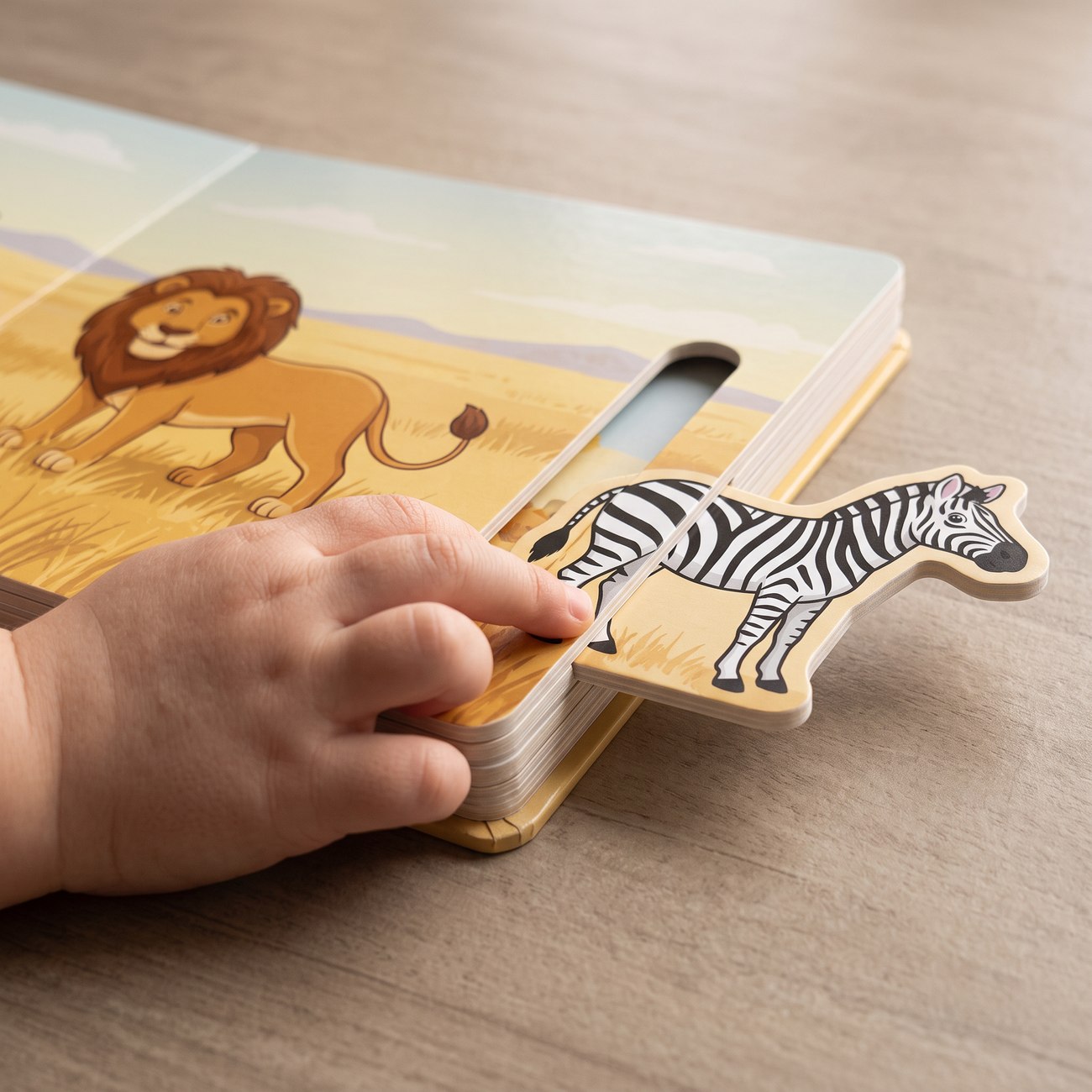
He wants to do it again. And the word comes along with it.
That second part is the one that matters. The hard bit was never knowing what to say. The hard bit is a one-year-old who will not sit still for the same page a fourth time.
So you stop having to be the entertainer. He runs it. You just say the word. And the twentieth repetition happens on a Tuesday without you noticing it happened, because you were not the one counting and you were not the one pushing.
Put the two books side by side and the difference is not subtle. It is not a better version of the same object. It is a different object that happens to also be a book.
| A typical first-words book | Little Lifters | |
|---|---|---|
| Words per page | A sentence or two | One |
| Pictures | A busy scene | One |
| Turns the page | You do | He does |
| His hands | Idle | Lift, slide, pull |
| Fourth read | He has gone | He asks again |
| Per book | $6.99 to $9.99 | $4.50 |
The row that does the most work is the fourth reading. Everything else on that table is a design choice. That row is the whole argument, because the thing you have actually been fighting is not comprehension and it is not attention span. It is the fourth time.
It is not just you, and that is the part nobody says out loud
Before I found these I spent a lot of evenings reading other parents saying the same thing in slightly different words. Every quote below is somebody else's, lifted exactly as they wrote it.
Reading to my 15 month old feels ridiculous?Parent of a 15-month-old · r/toddlers
Too many words to too many pictures.Parent of a toddler · r/toddlers
I am also introverted and I feel silly narrating.An introverted parent · r/NewParents
its exausting and i feel stupid, but she likes it lolParent of a daughter · r/NewParents
My son is 23mo and still won't sit for a whole story.Parent of a 23-month-old · r/toddlers
no matter how great the book, too many words and kids lose interest.Parent of a toddler · r/toddlers
My 9 month old also loves books but quickly loses interest if there's too many words.Parent of a 9-month-old · r/NewParents
He won't sit for much of a storyParent of a son · r/childrensbooks
So many of them are just clunky.Parent of a toddler · r/toddlers
some of them are mindnumbingA mom · r/Mommit
A lot of things feel ridiculous at that age. It's okay. Do it anyway.A parent replying · r/toddlers
won't sit for long if I don't turn the page every…A new parent · r/NewParents
Twelve quotes, twelve different people, none of them talking about a product. Public posts on parenting forums, quoted word for word including the typos. The line under each one is what that parent said about themselves in the post. We did not write any of these and nobody was paid.
How it works, in three steps
1. Pick a book. There are ten: Animal, Ocean, Number, Color, Job, Compare, Vehicle, Shape, Farm, Fruit. Whichever one he reaches for. He will have a favorite within a week and it will not be the one you expect.
2. Say the word on the page. Just the word. Not a sentence about the word, not a question about the word. banana. lion. purple.
3. Let him work the flap. Then say it again. And when he pulls it a fourth time, say it a fourth time, in the same voice, without turning it into a lesson.
Five to ten minutes. That is the whole of it. Not a program, not a system, nothing to subscribe to and nothing to keep up with. A book, a lap, and the same word more times than feels sensible.
There is a version of this where you do it wrong, and it is worth naming so you can stop worrying about it. You cannot do it wrong by saying the word too flatly, or by only getting through two pages, or by letting him skip to the zebra every single night for a week. The only way to get no value out of the set is to turn it into a lesson. The moment you start asking him to perform the word back to you, he stops reaching for the book, and the thing that was working stops working.
Say the word. Let him pull the tab. Say it again. That is genuinely the entire instruction, and the reason it reads as too simple is that the design did the complicated part already.
Just imagine what a month of this looks like
Not a transformation. Nothing you could point at and photograph. Something smaller and much more ordinary than that.
A month in, the box lives on the floor rather than the shelf, because it gets opened. He has a favorite. It is the one with the zebra. He goes and gets it himself and brings it to wherever you are sitting.
That is a different thing entirely from you suggesting a book and him leaving the room.
You are not reading to him anymore. You are both looking at the same page while he operates it, and your job has shrunk to one word, said in a normal voice, as many times as he wants it.
He brings you the book.That is the change. It sounds small until it happens.
And at some point in the fifth or sixth week there is a morning where he says one of them. Not prompted, not performed, not at bedtime. Standing at the counter pointing at the fruit bowl, except this time with a word attached, in the slightly wrong shape that first words always come in.
You will not know which of the five hundred repetitions did it. That is the honest part. What you will know is that the repetitions happened, that they happened without an argument, and that you were not the one dragging it along.
If it is not the right stage for him
Email us inside 30 days of delivery and we refund it. The whole argument on this page is that books get bought for the wrong stage, so making that hard to undo would be a poor look. Keep the box, use the set for two weeks, and if he is not reaching for it, that is reason enough.
What happens if you do nothing
Nothing dramatic. That is sort of the problem.
There is no moment. Nothing goes wrong on a particular Tuesday. You carry on in the shape you are in now. The books stay on the shelf. Reading stays a thing you both get through rather than a thing you both like. And you keep carrying that low background sense of not quite doing enough.
And the bit that stings, looking back, is the explanation you land on while you wait. Because when something does not work for months, you do explain it to yourself. You decide he is not a book child. Or you decide you are not consistent enough, not patient enough, not the sort of mother who manages the bedtime story. Both of those sit in you, neither is true, and the longer it goes on the more fixed they get.
Meanwhile every week is another week he is handed a spread built for a child who can follow a story, and asked to find one word in it.
He is not behind the book. The book is ahead of him.
That is a much smaller problem than the one you have been carrying around, and it has the enormous advantage of being fixable tonight.
What it actually looks like
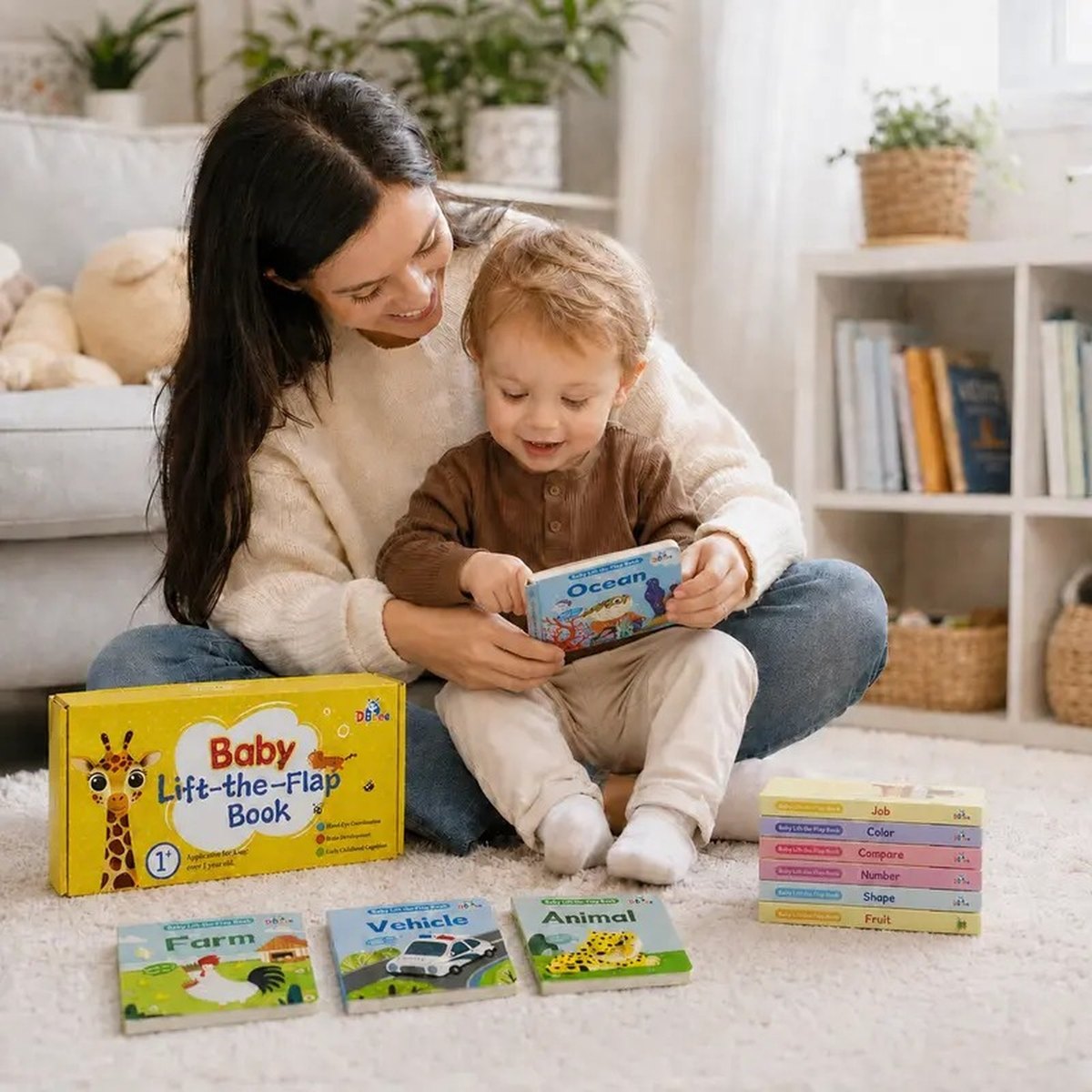
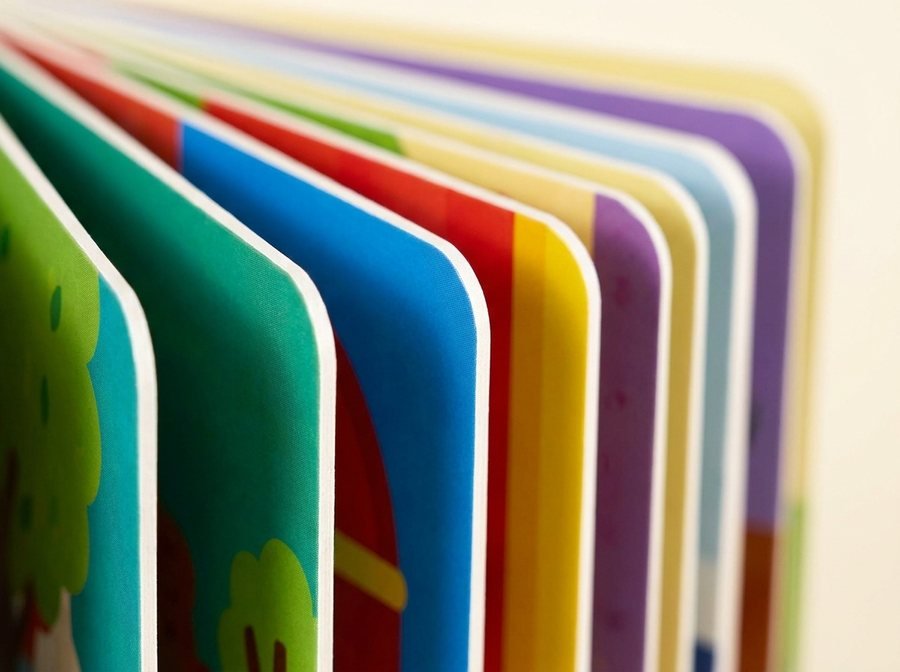
Photographs of the set itself, not customer submissions. When buyers send us their own we will put those here instead and say so.
What is in the box
Ten board books. One topic each. One word a page.
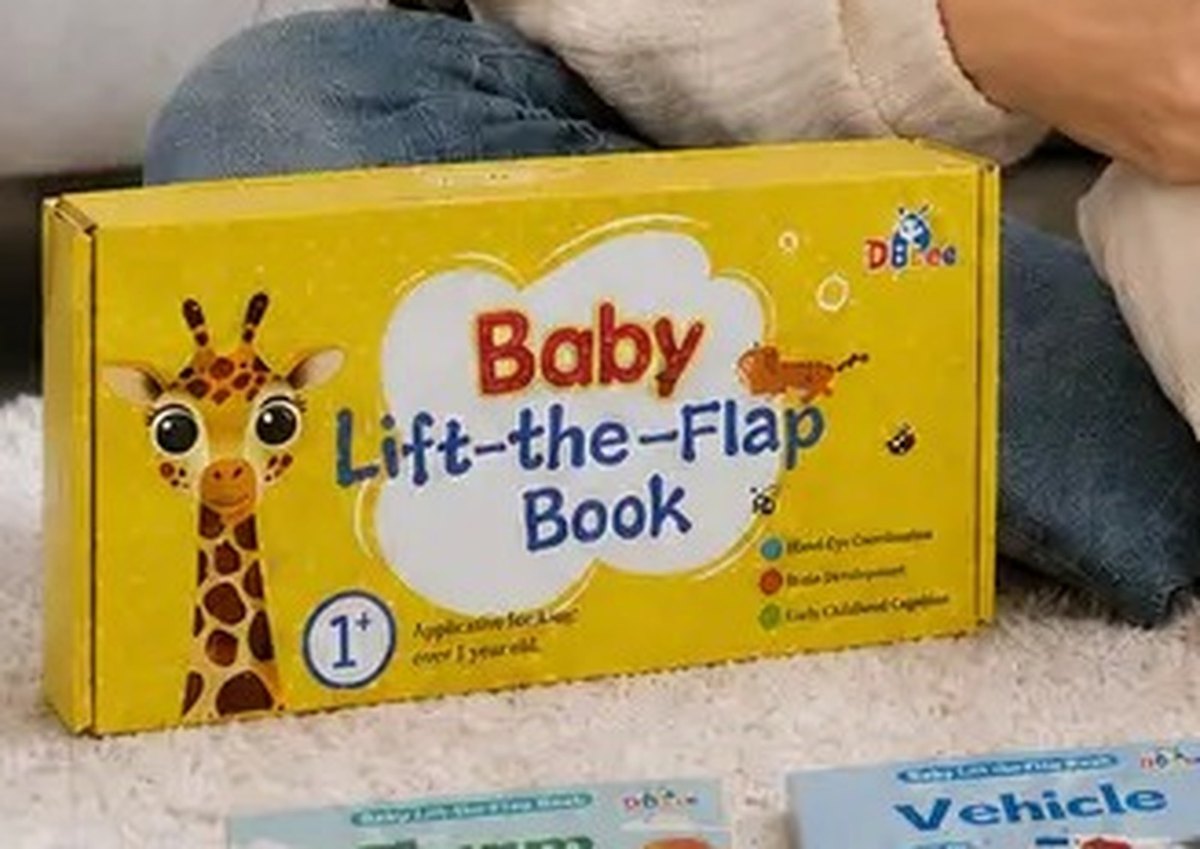
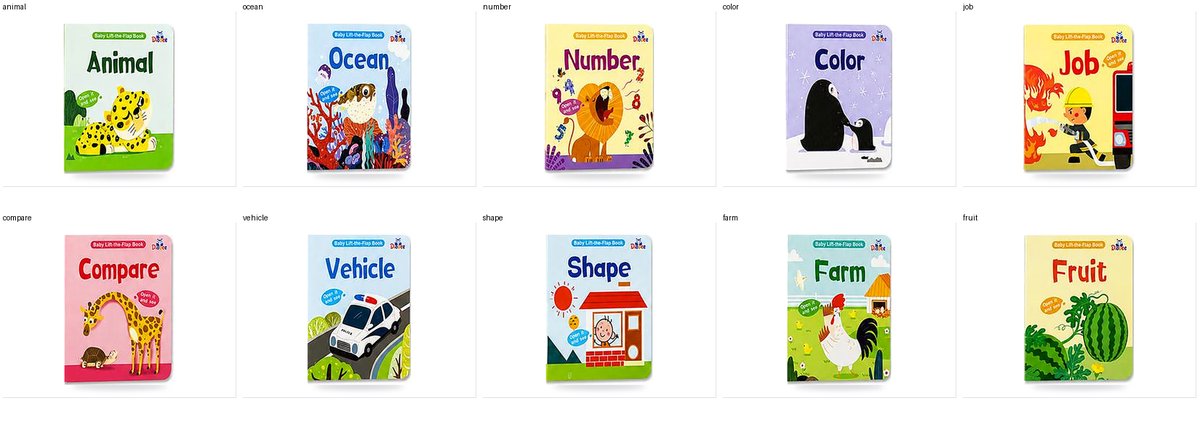
| Books | 10 |
|---|---|
| Topics | Animal, Ocean, Number, Color, Job, Compare, Vehicle, Shape, Farm, Fruit |
| Things to do | Lift a flap · slide a tile · pull a tab |
| Pages | Thick board, white core, rounded corners |
| Flaps | Cut from the board itself, not glued paper |
| Age | 1 to 3 |
| Packaging | Lidded box, no wrapping needed |
The flaps are the row that matters. A paper flap needs a careful pinch, which is why paper flaps last about a week. These are cut from the board. He can get a whole hand on one and haul it open, which is exactly what he is going to do.
Check Availability »What it costs, and why not from the bookstore
| What you take | Books | You pay | Per book |
|---|---|---|---|
| One set | 10 | $44.99 | $4.50 |
| Two sets, 3rd free | 30 | $89.98 | $3.00 |
| A bookstore | 1 | $6.99 to $9.99 | $6.99+ |
Ten books for the price of five.And the fifth one they sell you is one topic, which is finished in a week.
The three-set option also comes with the First Words 12-Week Plan, a $19.99 digital download: twelve weekly pages telling you which book to open and which word to say. Free, and you do not have to use it. Free US shipping on every order.
You will not find the ten-book set put together this way on a shelf anywhere. Bookstores sell these one at a time, because one at a time is how a bookstore works. The whole point is ten of them.
Why would anyone need three sets? One stays downstairs. One lives in the car. One is wrapped in a cabinet for the next birthday you forget about until the night before.
Apply Discount & Check AvailabilityThe questions I had, in the order I had them
He is only one. Is this not too early?
It is built for exactly this. The reason the usual first-words book feels too early is that it asks him to follow a sentence and scan a crowded picture, and he cannot do either yet. One word next to one picture is the version he can do now. The set is marked ages 1 to 3, and the first year of that range is the one it is actually designed around.
He destroys books. How long will these last?
The flaps are cut from the board itself, not glued paper tabs, which is the single difference between a flap that survives a one-year-old and one that comes off in week two. Every page and every cover is thick board with rounded corners. He will get a whole fist on a flap and haul it. That is what it is for.
Ten seems like a lot. Could I just get one and see?
You can buy one lift-the-flap board book anywhere for $6.99 to $9.99, and the honest answer is that one book will not tell you anything. One book is one topic, and one topic is finished inside a week. The whole mechanism here is that he keeps reaching for it, and he keeps reaching for it because there are ten of them and a different one is interesting on a different night.
What if he just plays with the flaps and ignores the word?
He will, at first, and that is fine. The flap is not the lesson. The flap is the reason the page gets opened a fourth and a fifth time. Each of those times, the word is sitting there on its own with nothing competing with it. You saying it out loud, flatly, without making it a test, is the part that matters.
Is this a program? Do I have to keep up with something?
No. There is no app, no schedule, no subscription and nothing to log. It is ten books in a box. Five to ten minutes on a lap when he brings you one.
What if it is not right for him?
Email us inside 30 days of delivery and we refund it. The whole argument on this page is that books get bought for the wrong stage, so making that hard to undo would be a poor look.
Here is what to do next
Pick the one-set option if you want to see it first, or the three-set option if you have more than one child, a birthday coming, or a car you would rather not have empty.
It arrives in the box. You do not have to prepare anything or read anything first. Tonight, or whichever night it turns up, take the lid off and let him pick. He will pick the one with the animal on the front, because they all do.
Then say the word on the page, and when he pulls the tab, say it again.
The only thing you really risk here is another month of the shelf. That is the actual alternative on the table, and it is not dramatic, which is exactly what makes it easy to pick. Another month of a book that is ahead of him, another month of reading being a thing you get through, another month of the quiet explanation that it is somehow you or somehow him.
It was neither. It was the page.
Check Availability & Apply DiscountWhere these numbers come from
- $44.99 for the set of ten, regular $59.99, and $89.98 for three sets. Our own pricing, listed on the product page. The per-book figures of $4.50 and $3.00 are those prices divided by ten and thirty.
- 4.9 out of 5 from 550 reviews. The set's rating on TikTok Shop, where it has been selling to parents. Not our reviews, and none of them were written by us.
- $6.99 to $9.99 for a single lift-the-flap board book, $39.99 for a five-book collection. Shelf prices for comparable single titles and boxed collections at general bookstores, checked October 2026.
- Ten topics: Animal, Ocean, Number, Color, Job, Compare, Vehicle, Shape, Farm, Fruit. Three mechanics: lift-the-flap, push-pull slider, pull-out. Both counted off the set itself.
- Ages 1 to 3 is the manufacturer's marking on the box.
Nothing on this page cites developmental research, and that is deliberate. This page describes what the object is, what it costs, and what the routine looks like. What it does for any particular child is not ours to promise.